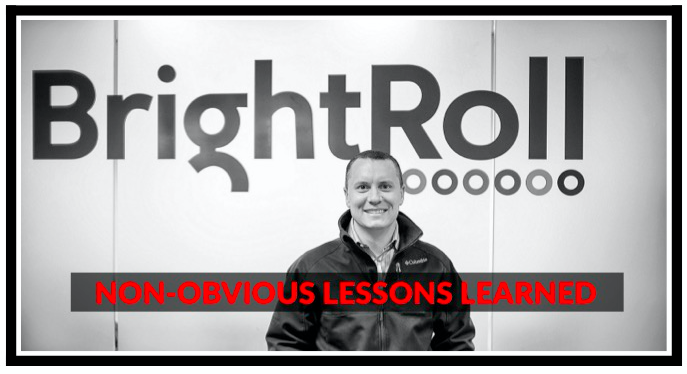
I recently gave a talk at Yahoo! about the lessons learned from founding, building and selling BrightRoll. This is a summary of my talk.
I founded BrightRoll in 2006 and sold the company to Yahoo in 2014 for $640M.
I have learned a tremendous amount over the past 10 years and much of those learnings are covered well in the writings of others (here, here & here). That said, there were seven non-obvious lessons I learned that I believe can add value to founders everywhere.
At BrightRoll, we accomplished many great things and have a lot to be proud of. We had nine straight years of revenue growth, demonstrated material profitability, made a big impact on the advertising industry and did all of this with a minimal amount of capital raised.
In fact, if you invested $100k in our Series A financing, you would have made roughly $6M when we sold the business — a 60x return on your money. For most of our Series A investors BrightRoll is a top 3 realized return out of hundreds of investments.
That said, while the growth and trajectory of the business appear linear, our path was anything but. We struggled at many points and executed multiple pivots. Time has provided great perspective on our journey and here are a few of the non-obvious lessons we learned.
Lesson #1: Overspend
The conventional wisdom of startups is to be frugal in all you do. This frugality mantra hides the very important fact that you also need to know when to overspend.
In 2006, we executed a business model pivot where we moved our focus from generating revenue from performance advertising to brand advertising. This reduced our revenue back down to zero and was a “bet the company” decision. One of the fundamental differences between the two models is that in brand advertising you need to sell directly to advertisers or ad agencies.
Since none of the founding team had any sales experience, I focused on hiring the most senior and respected sales person I could find. The only way to close this individual was to offer them a significant premium in salary compensation (their annual salary equated to nearly half of the total cash remaining in the company) and a sizable portion of our outstanding equity. Instead of being frugal, we offered everything we had.
The results? Eight years later that individual managed over 50 sales people and hundreds of millions of dollars in revenue.
Side note: Over the years we used the exact same strategy to hire a couple of other management team members and it had an equally important impact and results.
As an investor, one of my favorite questions to ask startup founders is, “What is most important right now?” Most often than not, the answer is “hiring great people.” My follow up question is always the same. “So, how much do you spend on talent acquisition?”
Here is the brutal truth — talent acquisition employees are universally underpaid. While you will rarely find successful sales companies with low sales compensation, you nearly always find talent focused companies with little or no investment in their talent acquisition organization.
One of our most critical decisions we made at BrightRoll was to hire a senior head of talent acquisition and to pay them appropriately. At the time, many members of my team challenged my logic and felt we could execute a hiring plan with much more cost efficient options.
Fundamentally, they were wrong. Over the six subsequent months, our engineering hiring trajectory was completely transformed, with it being a competitive weapon. In fact, we were (finally) competing with far sexier startups at the time, like Facebook, Zynga and Twitter. The impact of this improved hiring cadence was undeniable and changed trajectory of our business.
As is typical following any acquisition, our team changed quite a bit as we came together with Yahoo and many of the original team left to pursue other opportunities. Occasionally, I like to peruse LinkedIn and find out where this specific head of talent acquisition. At last check they were splintered among the following companies — Accel, Affirm, Docker, MuleSoft, Rippling and many have founded their own business. Wow!
The lesson here is you can’t overspend on great people.
Lesson #2: Don’t Innovate
My mother has been a manager in Silicon Valley for over forty years and she often came to me with a variety of questions. These problems included everything from age discrimination in the workplace to how to manage out low performers. My mother’s advice was the same, “BrightRoll is an innovative company. You should find an innovative solution to this problem.”
Unfortunately, my standard answer was always, “that sounds like a distraction.” My experience at BrightRoll taught me specifically that the purpose of a startup is to limit innovation to the absolute core areas of your business and to aggressively copy instead of innovating in other areas.
For example, I am often asked, “how did you come up with the BrightRoll brand?” The answer is I found a name that was available on GoDaddy, did a quick poll and BrightRoll won. I paid $9 for the domain. Next, I found a cool logo and fonts online and created a modified version in Photoshop.
The same process should be used for your brand, your logo, your corporate website, your marketing collateral, your sales presentations even some of your product UIs (assuming they are not core). Don’t innovate where you don’t have to. Startup branding is a wasteland for unnecessary innovation. Furthermore, startups should have one brand, not a family of dozens of brands, which I see as common problem at many startups.
Employee management is another area where startups overthink, overwork and often fail in their attempt to be innovative. If you think you have a unique process for sourcing, attracting and hiring engineers, then by all means spend time on it. If you are successful, that effort could materially change the value of your company.
However, if you think it’s a good use of your time to try to innovate in employee on-boarding, performance management, peer reviews, promotions or weekly all hands meetings, you are mistaken at best and destroying your company at worst. Find friends who work at great companies and crowdsource the best practices. These best practices are widely understood, easily implemented, and the differences are minimal or arguably irrelevant.
We copied our quarterly planning process from Google, our weekly all hands from LinkedIn and the list of copied behaviors goes on and on.
In short, only innovate when you have to. Everything else is a distraction.
Lesson #3: Focus on Edge Cases
Silicon Valley is overflowing with the lore of minimum viable products and teams. However, there are times when your organization should actually be focused on edge cases.
Have you heard the trick question, “why do rock bands ask for green M&Ms in their dressing room?” The answer is “they don’t. Their tour managers ask for them.” Green M&Ms in your dressing room is a classic edge case and they provide crucial information about whether or not the promoter has their shit together. Properly focusing on edge cases can help reveal flaws in broader execution.
In 2013, my head of talent acquisition said he wanted to revamp our hiring process and focus primarily on the experience of the rejected candidate. My naive response was, “Wait, WTF?!? You want to focus on the people who waste our time?”
What I missed in that initial discussion but gained a deep appreciation for overtime was that rejected candidates are an edge case and an extremely important one. If you can make your hiring process amazing for a candidate who ultimately doesn’t get a job, imagine how positive the experience will be for everyone else. And, remember, you reject way more candidates than you hire, so you do any other type of candidate.
So, what did we do?
- Assign an internal champion for their interview and be in the lobby when the candidate arrives.
- Give them a personal tour, check in with them multiple times and walk them out. Never leave them in an empty office for more than 5 minutes.
- Design every step of the interview process to highlight our values and test for fit. One of our core values was GSD (get shit done) and gave an hour to candidates to demonstrate their abilities on a project.
- Give them full transparency into every part of the process (including all negative feedback) and let them know the second they were no longer viable for consideration.
- Ask them to grade our interview process after being rejected and give us direct feedback.
The results were impactful and my favorite metric of success was we hired multiple engineers that were referred by rejected candidates!
The other edge case that I love to talk about is the remote office. Have you ever worked in a remote office? In most cases, it sucks. The reason it sucks is that headquarters always focuses on a minimum viable version of every corporate function — a minimum viable all hands meeting, offsite, holiday party, distribution of schwag…and the list goes on.
The fix to this problem is simple. Just focus on the edge case, the remote office. I have heard of many headquarters-first companies. I have never heard of another company that was remote office first. If you make a corporate function remote office first, it will almost always also be great for headquarters.
The lesson here is simple — focus on edge cases when solving for the edge case raises the bar for the entire organization.
Lesson #4: Be An A**hole
While many startups subscribe to the “no a**hole rule,” I would argue that it is important for startups to know when, where and how to be an a**hole within their industry.
Bezos, Zuckerberg, Jobs and nearly every successful founding CEO I know has needed to aggressively throw their weight around at times. The lesson here is that there are instances that you must be an a**hole and those situations should only be external to your company (ie, in your industry), not internal.
In late 2008, the video advertising industry was in its nascency and the world economy was in a crisis. A media buyer at a large advertising firm saw a career making opportunity. He decided to move $20M of advertising dollars from TV to digital video.
This move immediately made this company the largest digital video advertiser in the world with nearly half of the entire digital video advertising market. The catch? The company wanted to pay a $3 CPM (cost per thousand impressions), which was nearly 10x less than the current market rate.
While it was safe to assume BrightRoll wasn’t the first company approached, it quickly became clear that we were the first to take the business. Our largest publisher partners at the time were ESPN, CNN and the like, and they all refused to accept the campaign when we brought it to them and told us they had also rejected it when the advertiser had approached them directly.
In fact, they not only said no but had some harsh words for us for taking the campaign ourselves. The CRO at a major TV network/publisher and the SVP, Sales at a large video site both called me personally to tell me that, “I had single handedly ruined the video advertising business”, and that this was an “a**hole move.”
What those partners misunderstood was this was classic market disruption. They had limited inventory and felt the need to hold prices high through a recession. We were a software platform that owned no inventory but had access to nearly infinite unsold inventory. Low price, high volume advertising campaigns played to our strengths and this advertiser became one of our largest, and arguably our most important, advertising partners for years.
Another example of effectively being an a**hole also came in 2008. At the time, many competitors of ours were selling video advertising campaigns and then running them in display inventory without their customers knowledge. These competitors were hard to compete with because they could sell campaigns at half the price and the client would just assume they had a better technology or better publisher relationships. In reality, these competitors were cheating.
After failing to convince buyers that this practice was not in their best interest, I decided to jump in head first. I coined the provocative phrase “fake pre-roll” (which basically means fake video advertising), and wrote a byline for AdWeek explaining the issue. I then posted on my blog an article with all the companies involved, the advertisers and campaigns, screenshots, links and more detail.
Publicly calling out your customers is undoubtedly risky and directly naming your competitors is bold. Does it make you an a**hole? Guilty as charged, but effective nonetheless.
Four years later the fake pre-roll issue had actually grown dramatically. One of our competitors took my idea even further. They bought the domain FakePreroll.com and developed an even more robust marketing campaign around the issue. As they say, one a**hole deserves another.
The lesson here is to be prepared to be an effective a**hole in your industry, when necessary.
Note: These t-shirts are not a joke and are actually made by a startup. The only more obnoxious t-shirts I have seen were from my former employer, an investment bank named Robertson Stephens, in 2000. Those t-shirts included the claim “It’s your economy, we’ll take it from here” and the hilarious claim “There’s no bull market for good ideas.”
Lesson #5: Get a Low Valuation
“You set the price and I’ll set the terms.” — unknown genius
Before BrightRoll, I worked at a company called Plaxo and we had a board that founders dream of. Our board members included Ram Shriram, Tim Koogle, Ron Conway, Jon Callaghan and others. The only problem was that we spent a full week preparing for each board meeting and another week dealing with the action items from each board meeting every month. We were left with roughly two weeks a month to get anything done.
At BrightRoll, our fundraising priorities were (in order):
- Raise money from people we knew personally
- Ensure those investors had a low likelihood of screwing up the company
- Get fair, clean terms
This prioritization will always lead to a low valuation. Why? First, limiting your investor pool to only people you know is excluding many potential investors. Second, requiring clean terms is a de facto guarantee that you will receive a lower valuation than you could have.
We met once a quarter as a board for nine years and had essentially no board level issues. We never even had a single legal term requirement over four rounds of financing
The results? In 2008, at the peak of the financial crisis, we didn’t need to lay off a single employee and we raised another $10M from our existing investors. Six years later we sold the company with one of the cleanest capitalization tables our lawyers had seen in their career.
From 2011–2013, two of our largest competitors raised huge amounts of money, which put their total capital raised at well over 2x ours. Their terms were not clean and they chose to optimize for valuation over other important factors. Both companies were eventually forced to go public by their investors and when we sold in 2014 their combined market capitalization was less than 1/2 of our sale price.
The lesson here is that high valuations do not equal success. 10% of something is worth more than 50% of nothing.
Lesson #6: Be Tribal
My last two lessons are about culture and the best book I have ever read about successful startup culture. The book is Tribe by Sebastian Junger. Ironically, the book is not about startups or culture.
The book discusses the fact that “we have a strong instinct to belong to small groups defined by clear purpose and understanding. These groups are called tribes. Startups are not families, battalions or even worse analogies like professional sports teams.
Startups are tribes. Or, at least the successful ones are.
While politics shouldn’t have a place within a startup, tribalism should run rampant. Tribe members protect one another, look out for one another, hold each other accountable and respect status based on value add rather than name or title. Tribes cultivate incredible loyalty, shared purpose and an egalitarian ethos. When people belong to a tribe, their loyalty is to the tribe. When that tribe is a startup, they move mountains for the company.
One area in which this tribalism can pay huge dividends is in competitive information. One of the best sources for competitive information for startups are your customers. Customers tell your employees information all the time about your competitors, products and challenges. If your startup is a tribe, every edge of your company becomes a touch point for information flow back to HQ. The depth of information we received over the years still has me shaking my head in disbelief.
If the worst mistake is not turning your company into a tribe, then the second worst is not realizing when your competitors have succeeded in doing so. To be specific, interview a competitive tribe’s employees at your peril.
A second area where tribalism is a huge advantage is in talent retention. The majority of the first ten employees at BrightRoll are still working together ten years later! That doesn’t happen in startups, it happens in tribes. Employees that depart successful tribes create a strong feeling of betrayal and collective outrage within their peer group. Remember, in tribal societies, an individual employee departing a startup actually does put the tribe at increased risk of survival.
At one point, our team became so frustrated by the constant attempts to poach our employees that we decided to create a honeypot. We essentially created a profile for a fake engineer at BrightRoll and then we shared internally all the inbound interest this “employee” received from recruiters. This was a win-win. Our engineering team found comfort in knowing that other people at the company were fully aware of their market value, and management gained powerful transparency into what competitors were saying to our engineers everyday.
Side note: One of my other favorite information gathering tricks was to have the @brightroll.com email catch all into a single address. The amount of information that comes via misspelled email addresses and carpet bombing spam is unbelievable.
In startups, you have few competitive tools and tribalism can be one of the most powerful.
Lesson #7: Love Being Last
One of my favorite passages in the Junger’s book defines tribal behavior:
“Acting in a tribal way simply means being willing to make a substantial sacrifice for your community.”
And sacrifice you will. In fact, the best definition I know of an entrepreneur is someone who steals ideas from home and takes them to work.
As a founding CEO you will make significant sacrifices and many of them will come from home. You will sacrifice time with your family, your friends, your kids and, at many times, you will be living a lonely existence. Again, from Junger:
“True leadership — the kind that lives depend on — may require powerful people to put themselves last.”
True startup leadership does require you to be willing to be last. In fact, you should love being last. As a founding CEO you will undoubtedly be the last to leave the office, last to go on vacation, last to paid a full salary and last to receive liquidity.
To be clear, I‘m not arguing that the founder is a victim. Far from it. I’m arguing that being a successful founding CEO requires a variety of skills, sacrifice and leadership. Furthermore, it’s precisely the unique mix of excitement and boredom, of possible riches and risks, that makes the journey so challenging yet rewarding.
Dedicating nine years of my professional life to building a startup, with all the required commitment and sacrifice, was a joint decision and I benefitted greatly from an incredibly supportive wife and family. Upon reflection, I would make the same decision and revel in all my family and I have gained from it.
In fact, I am firmly in a state of post-traumatic growth.
Post-traumatic growth is positive psychological state experienced as a result of adversity and other challenges in order to rise to a higher level of functioning.”
And, what an amazing and fortunate state to be in. If I can, I would love to be in this state for the rest of my life. And if that means being last — then let me know where to sign up!